
HPV in Singapore
HPV (Human Papillomavirus) is the most common sexually transmitted infection globally. Most infections clear on their own, but some high-risk strains can cause cervical, anal, throat and other cancers. Mediway Medical Centre offers HPV vaccination, testing and cervical screening at our clinic at The Riverwalk, Clarke Quay.

- VaccinationFrom $330/doseGardasil-9
- 3-dose course$900Ages 15-45
- HPV DNA test$180Women (cervical)
- Pap + HPV co-test$220Cervical screening
- Ages covered9 to 45Males + females
- LocationThe RiverwalkClarke Quay MRT
- ~80%Sexually active adults exposed at some point
- 14High-risk strains linked to cancer
- ~90%Clear infection naturally within 1 to 2 years
- 9–45Vaccination eligible age range (years)
- Gardasil-9Covers 9 strains · offered at Mediway
Per CDC · NCCS · MOH SG · Educational referenceFrom $330
What is HPV?
HPV (Human Papillomavirus) is a family of over 200 related viruses. It's the most common sexually transmitted infection globally, with estimates suggesting up to 80% of sexually active adults will be exposed at some point.
Most HPV infections are harmless and clear on their own within 1 to 2 years as the immune system controls the virus. But a small minority of infections persist, and if caused by high-risk strains, can lead to cellular changes that develop into cancer over years.
HPV strains: high-risk vs low-risk
Not all HPV is the same. Of 200+ strains, around 40 infect the genital area. Clinically they split into two categories:
Low-risk HPV
Types 6, 11 (main) + others
Cause genital warts (condylomata acuminata) on the genital, anal, or oral area. Flesh-coloured or pink, often painless.
- Do not cause cancer
- Warts can be treated (cryotherapy, electrocautery, topical)
- Gardasil-9 covers types 6 and 11 (prevents most wart cases)
- Warts can recur because the virus stays in the body
High-risk (oncogenic) HPV
Types 16, 18, 31, 33, 45, 52, 58 + others
Don't usually cause warts. Cause cellular changes in mucous membranes (cervix, anus, throat) that can progress to cancer over years if untreated.
- Types 16 and 18 alone cause ~70% of cervical cancers
- Persistent infection (years) is the cancer risk; transient infection is not
- Gardasil-9 covers 7 high-risk types (16, 18, 31, 33, 45, 52, 58)
- Screening (pap + HPV DNA) catches changes before cancer develops
Key insight: Gardasil-9 protects against both categories, 9 strains in total. The earlier you vaccinate (ideally before sexual debut), the more complete the protection.
Cancers caused by HPV
HPV is responsible for the vast majority of cervical cancer cases and a significant share of anal, throat, and other cancers, in both women and men.
-
Cervical cancer
~99% of cervical cancers are caused by HPV. The 3rd most common cancer in Singapore women.
-
Anal cancer
~90% of anal cancers are HPV-caused. Higher incidence in MSM and immunocompromised patients.
-
Oropharyngeal cancer
~70% of throat cancers are HPV-caused (mainly type 16). Rising incidence in men.
-
Vulvar cancer
~50% of vulvar cancers are HPV-caused.
-
Vaginal cancer
~75% of vaginal cancers are HPV-caused.
-
Penile cancer
~60% of penile cancers are HPV-caused. Rare but serious when it occurs.
Combined, HPV-caused cancers affect tens of thousands of people worldwide each year. Vaccination + screening prevent almost all of them.
HPV services at Mediway
Three HPV services at our clinic, supporting both prevention and screening.
HPV vaccination
- From $330/dose
- $900 for 3-dose course
Gardasil-9 covering 9 HPV strains, the broadest protection available. Ages 9 to 45, both men and women. 2 doses for under-15s, 3 doses for 15-45.
Full vaccination serviceHPV DNA testing
- $180 women (cervical)
- $250 men (urine-based)
Detects high-risk HPV strains before they cause cellular changes. Available as cervical HPV DNA Test for women, or a urine-based Male HPV Test for men. Mediway does not perform anal HPV testing.
Full testing servicePap smear + cervical screening
- $60 pap alone
- $220 pap + HPV co-test
Pap smear (Thin Prep) detects cervical cellular changes. Co-tested with HPV DNA for women aged 30+ per Singapore screening guidelines.
Pap smear serviceHPV vaccination at Mediway
HPV vaccination is one of the most effective cancer-prevention tools available. Mediway administers Gardasil-9, the broadest-coverage HPV vaccine, protecting against 9 strains (6, 11, 16, 18, 31, 33, 45, 52, 58).
- Children aged 9-14: 2 doses, 6-12 months apart. Most effective age group, before sexual debut.
- Teens and young adults 15-26: 3 doses (0, 2, 6 months). Still highly beneficial.
- Adult catch-up 27-45: 3 doses. Approved by HSA. Even with prior HPV exposure, the vaccine covers strains you haven't yet encountered.
- Men: Yes. The vaccine prevents anal, throat, and penile cancers, and reduces transmission to partners.
For full vaccination pricing, schedule, and booking: HPV Vaccination page.
Cervical cancer screening for women
Regular screening catches cellular changes before they become cancer. Singapore's Health Promotion Board recommends:
- Ages 25-29: Pap smear every 3 years
- Ages 30-69: Pap smear + HPV DNA co-test every 5 years (or pap alone every 3 years if preferred)
- Earlier or more frequent screening may be recommended based on history (abnormal previous results, immunosuppression, multiple partners, etc.)
- Stop screening at age 70 if prior screenings have been negative
Screening is important even if you're vaccinated, as vaccination doesn't cover every cancer-causing strain, and existing infections (pre-vaccination) can still progress.
For pap smear pricing and booking: Pap Smear page.
HPV in men
HPV is often discussed as a "women's issue" because of cervical cancer, but it affects men too, sometimes without symptoms for years.
- Vaccination benefits men directly, preventing anal, throat, and penile cancers, plus genital warts. Recommended for men aged 9-45.
- There is no routine HPV screening test for men (no male equivalent of pap smear). Most HPV infections in men clear naturally and cause no symptoms.
- Mediway offers a urine-based Male HPV Test at $250 for men who want clarity on their HPV status. The test uses a first-void urine specimen, no swab required. For anal HPV testing, please consult a colorectal specialist as Mediway does not perform anal HPV testing.
- Genital warts are visible and can be diagnosed clinically. Treatment is available; we refer to specialists for wart removal.
- Vaccinating men reduces community transmission, protecting female partners even where direct male benefit is debated.
Your privacy, fully protected
HPV-related care is sensitive for many patients. Privacy is protected end-to-end.
Discreet clinic location
Basement level of The Riverwalk, inside a shared medical floor, not a street-front storefront.
No records shared with insurers or employers by default
HPV test results, vaccination records, and pap smear results are not shared with insurers, employers, or other third parties unless you specifically request it. HPV and cervical screening are not on the MOH list of notifiable infectious diseases; vaccination is recorded in the National Immunisation Registry as standard.
Self-pay option
Pay privately for HPV services to keep them entirely outside insurance systems.
Digital result delivery
Phone, WhatsApp, or secure email, whichever you prefer.
PDPA-compliant handling
Data managed per Singapore's Personal Data Protection Act. See our full Privacy Policy.
Frequently asked questions
01What is HPV?
HPV (Human Papillomavirus) is a family of over 200 viruses, the most common sexually transmitted infection globally. Most HPV infections clear on their own within 1-2 years. Some high-risk strains can cause cervical, anal, throat, and other cancers; low-risk strains cause genital warts.
02What's the difference between high-risk and low-risk HPV?
Low-risk HPV strains (mainly types 6 and 11) cause genital warts but don't cause cancer. High-risk HPV strains (types 16, 18, 31, 33, 45, 52, 58 and others) don't typically cause warts but can lead to cervical, anal, throat, penile, and vulvar cancers over years of persistent infection. Gardasil-9 protects against 9 strains covering both categories.
03Do men need HPV vaccination too?
Yes. HPV causes anal cancer, throat cancer, and penile cancer in men. Vaccination also reduces transmission to female partners. HSA and most clinical guidelines recommend HPV vaccination for men aged 9-45 in Singapore.
04Can HPV be cured?
There's no medication to eliminate HPV from the body. However, most HPV infections clear naturally within 1-2 years as the immune system controls the virus. For complications (genital warts, cervical cellular changes), treatment is available.
05If I'm sexually active, is the HPV vaccine still worth it?
Yes. Even if you've been exposed to some HPV strains, Gardasil-9 protects against 9 strains, and it's unlikely you've encountered all of them. HSA approves vaccination up to age 45 for this reason.
06How often should I get a pap smear in Singapore?
Singapore Health Promotion Board recommends pap smear every 3 years from age 25 to 29, then every 5 years (with HPV co-testing) from age 30 to 69 for women who have been sexually active. Earlier or more frequent screening may be recommended based on your history.
07Is HPV testing available for men?
There is no FDA-approved routine HPV screening test for men. Mediway offers a urine-based Male HPV Test at $250 for men who want clarity on their HPV status. The sample is collected from a first-void urine specimen, no swab required. Mediway does not perform anal HPV testing; for that, please consult a colorectal specialist. Visible genital warts can be diagnosed clinically; persistent issues are evaluated case by case.
Book HPV Vaccination or Testing
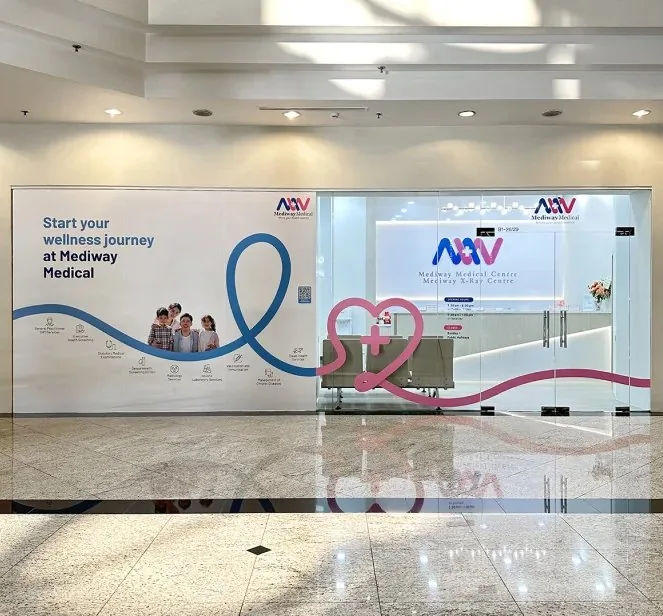
Located at The Riverwalk, a 2-minute walk from Clarke Quay MRT (Exit E). Same-day slots usually available.
- 20 Upper Circular Rd, #B1-26/29 The Riverwalk, Singapore 058416
- Clarke Quay MRT (NE5), Exit E · 2-minute walk
- Hours: Mon to Fri 7:30am to 6pm · Sat 7:30am to 1pm
Directions
Located in central Singapore, just a 2-minute walk from Clarke Quay MRT.
Clarke Quay Station (NE5)
Exit E. 2-minute walk along the river towards The Riverwalk building. We are at #B1-26/29.
Opp Clarke Quay Station (B04239)
Bus No: 2, 12, 33, 54, 147, 190, 12E, TS3, 147A
Clarke Quay Station Exit E (B04222)
Bus No: NS1, NS2, 2, 2A, 12, 12E, 33, 51, 54, 61, 63, 80, 124, 145, 147, 166, 174, 174E, 190, 197, 851, 851E, 961, 961M
Opp High Street Centre (B04251)
Bus No: 32, 195, 195A
Boat Quay (B05029)
Bus No: NS1, NS2, 51, 61, 63, 63A, 80, 124, 145, 166, 174, 174E, 197, 851, 851E, 961, 961M
The Riverwalk Carpark
Mon–Fri before 5/6pm: $2.00 for 1st hr, $1.00 for next subsequent 30min from 7am to 5pm
Mon–Fri after 5/6pm: $3.21/entry from 5pm to 7am the following day
Sat: $2.00 for 1st hr, $1.00 for next subsequent 30min from 7am to 5pm, $3.21/entry from 5pm to 7am the following day
Sun/PH: $3.21/entry from 7am to 7am the following day